

Senior transportation services are becoming an essential part of modern aging societies. As families live farther apart and healthcare needs increase, reliable, transparent, and senior-friendly transportation is no longer a luxury—it is a necessity. Within this growing landscape, RideSenior has developed two closely connected but locally adapted service models: RideSenior Canada and RideSenior USA. While both operate under the same mission of dignity, safety, and peace of mind for older adults, their pricing structures reflect very different market realities in Canada and the United States. Understanding these differences helps families, caregivers, and partner organizations choose the most suitable senior transportation service with confidence.
At a high level, both RideSenior Canada and RideSenior USA are positioned within the broader ecosystem of senior transportation service, focusing on door-to-door or door-through-door assistance rather than simple point-to-point rides. The emphasis is not speed or surge-based pricing, but care, patience, and predictability. That philosophy shapes how prices are built, communicated, and justified in each country.
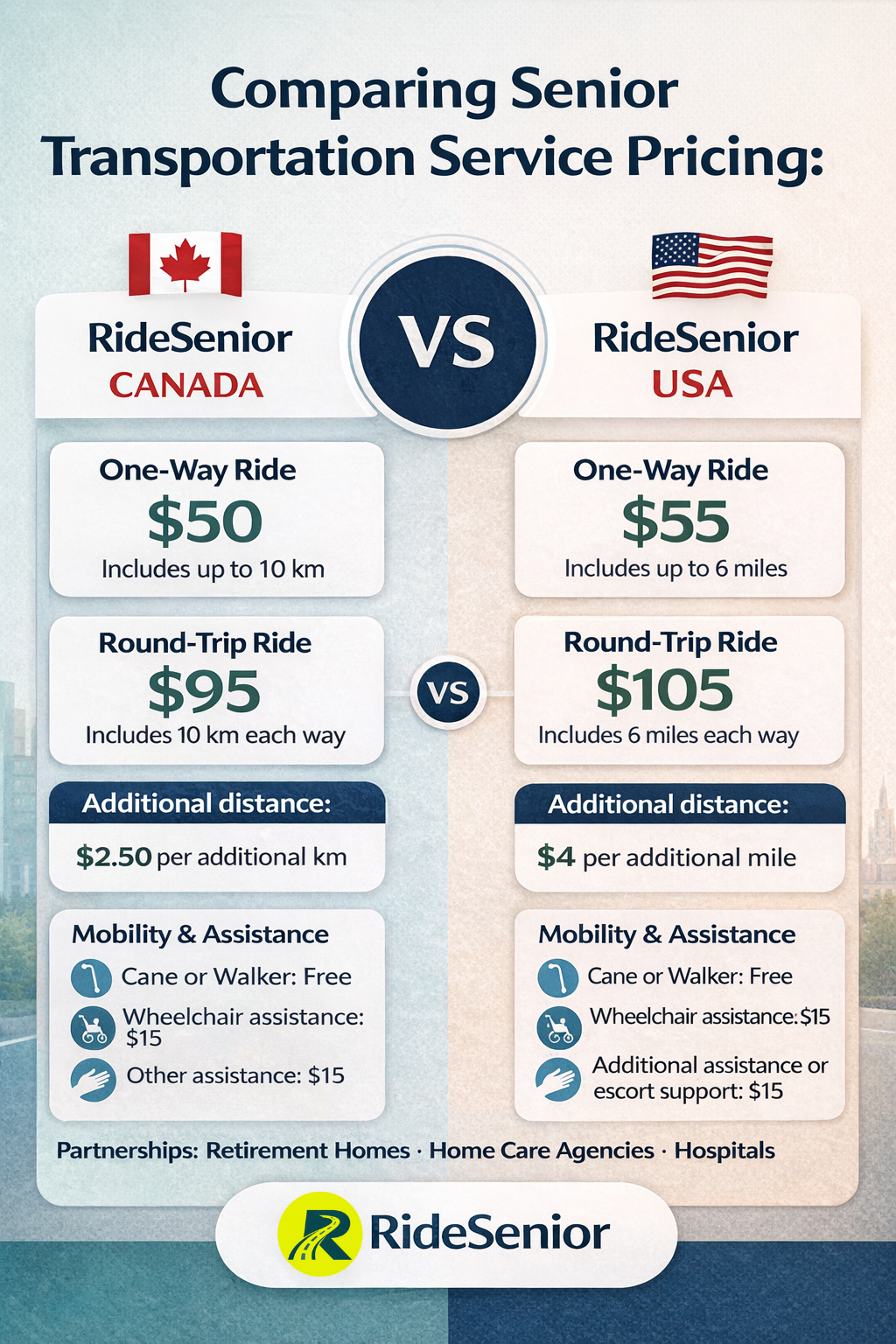
In Canada, RideSenior Canada adopts a kilometer-based pricing model that aligns with local driving habits, healthcare referrals, and provincial tax systems. A one-way ride is priced at $50 and includes up to 10 kilometers, while a round-trip ride is $95 and includes 10 kilometers each way. Any distance beyond the included kilometers is charged at a transparent rate of $2.50 per additional kilometer. This approach is intuitive for Canadian families, who are accustomed to thinking in kilometers and dealing with relatively stable fuel and insurance costs across provinces.
In contrast, RideSenior USA uses a mile-based structure that reflects American road systems, insurance frameworks, and consumer expectations. A one-way ride costs $55 and includes up to 6 miles, while a round-trip ride costs $105 and includes 6 miles each way. Additional distance is charged at $4 per extra mile. Importantly, this structure is intentionally kept unchanged because it fits the U.S. market extremely well, where longer travel distances, higher insurance premiums, and state-by-state regulatory differences require a slightly higher base fare.
Although the base numbers differ, the underlying philosophy is consistent. Both RideSenior Canada and RideSenior USA reject surge pricing and unpredictable fare jumps. Seniors and their families see the price clearly before confirming a booking, which is a crucial trust factor in the senior transportation service space. For older adults who rely on fixed incomes or scheduled medical appointments, cost predictability matters more than marginal discounts.
Another important point of comparison lies in how assistance and mobility support are priced. In both Canada and the United States, RideSenior provides free assistance for seniors using a cane or walker. This reflects an understanding that basic mobility aids should never become a financial barrier to independence. Wheelchair assistance is priced at $15 in both markets, covering the additional time, training, and physical support required to ensure safety. Other assistance or escort support, such as helping a senior navigate a hospital lobby or retirement residence, is also priced at $15. This symmetry across borders reinforces the brand’s commitment to fairness and consistency, regardless of geography.
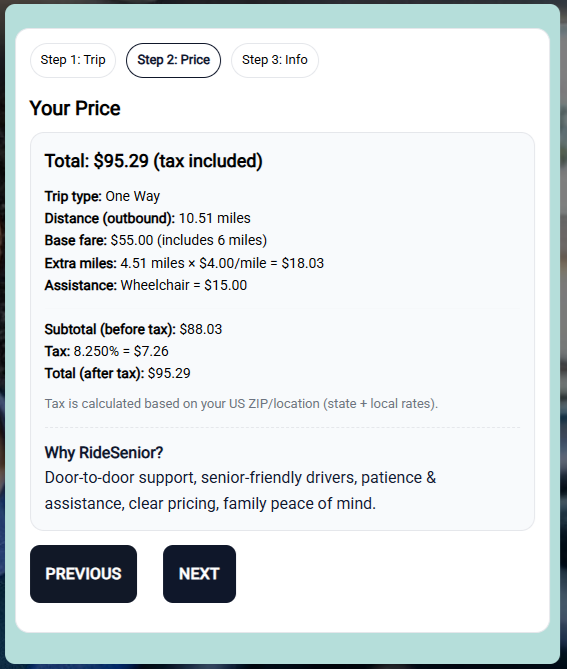
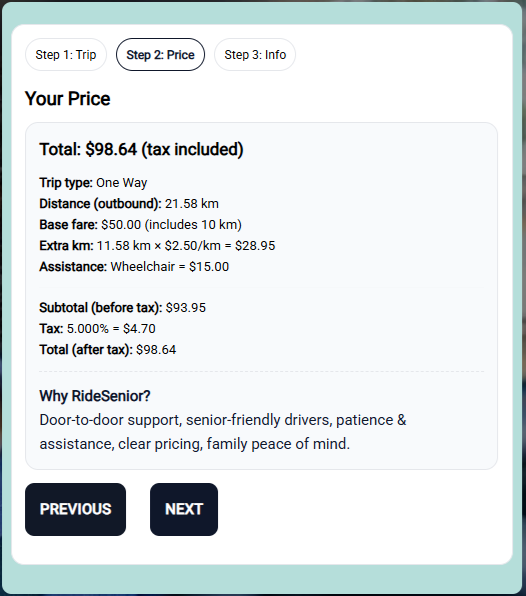
Taxes, however, are where the two markets diverge most visibly. In Canada, RideSenior Canada applies GST or HST depending on the province. For example, a ride in Alberta may only include a 5 percent tax, while other provinces apply harmonized rates. The tax is clearly shown in the price breakdown, allowing families to understand exactly how the final amount is calculated. In the United States, RideSenior USA calculates tax based on the rider’s ZIP code, combining state and local rates. This can result in higher or lower tax percentages depending on location, but the calculation remains transparent and visible before payment confirmation.
Beyond pure pricing, the difference between RideSenior Canada and RideSenior USA also reflects how senior transportation services integrate into local care ecosystems. In Canada, RideSenior Canada is naturally positioned to collaborate closely with publicly funded healthcare providers and community-based organizations. Partnerships with retirement homes, home care agencies, and hospitals are not only possible but strategically aligned with Canada’s healthcare structure. These institutions often require predictable, standardized pricing when referring seniors for non-emergency transportation, and RideSenior Canada’s kilometer-based model fits seamlessly into that requirement.
In the United States, RideSenior USA operates in a more fragmented healthcare and insurance environment. Private pay is more common, and families often compare multiple transportation options before booking. The slightly higher base fare in the U.S. reflects higher commercial insurance costs, labor expenses, and regulatory complexity. However, the clarity of the pricing model helps RideSenior USA stand out in a crowded senior transportation service market, where many providers rely on opaque quotes or variable fees.
From a family perspective, these pricing differences are less about cost and more about alignment with expectations. Canadian families often value stability, clarity, and alignment with public systems, while American families prioritize flexibility, responsiveness, and straightforward private pay options. RideSenior’s dual-market strategy respects these differences without compromising its core identity.
It is also important to consider how distance inclusion shapes perceived value. In Canada, including 10 kilometers in the base fare makes sense in urban and suburban contexts where many medical appointments and retirement residences are relatively close. In the U.S., including 6 miles achieves a similar balance, accounting for longer average travel distances while keeping the base fare reasonable. When viewed through this lens, the two pricing models are more similar than they initially appear.
The user experience reinforces this similarity. Whether booking through RideSenior Canada or RideSenior USA, families see a detailed price breakdown that explains base fare, included distance, additional distance, assistance fees, tax, and total cost. This level of detail is still rare across the broader senior transportation service industry, where vague quotes and post-ride adjustments remain common. By standardizing transparency, RideSenior builds long-term trust rather than focusing on short-term transactions.
Another shared characteristic is the absence of surge pricing. In both countries, RideSenior deliberately avoids demand-based fare increases. Seniors do not pay more simply because they need transportation during peak hours or urgent times. This policy is especially important for medical visits, dialysis appointments, or discharge pickups from hospitals, where timing is often non-negotiable. By keeping pricing stable, RideSenior differentiates itself from ride-hailing platforms that were never designed with older adults in mind.
When evaluating RideSenior Canada and RideSenior USA side by side, it becomes clear that the differences in pricing are not arbitrary. They are carefully calibrated responses to local regulations, cost structures, and cultural expectations. Yet the similarities in structure, transparency, and assistance policies reinforce a unified brand promise. Whether in Toronto, Edmonton, New York, or Phoenix, seniors and their families encounter the same values: respect, clarity, and reliability.
These values also make RideSenior an attractive partner for institutions. Retirement homes benefit from knowing exactly what residents will be charged. Home care agencies can confidently refer clients without worrying about hidden fees. Hospitals can coordinate discharge transportation with predictable outcomes. In both Canada and the United States, these partnerships strengthen RideSenior’s position as more than a transportation provider—it becomes part of the senior care continuum.
From an SEO and content perspective, comparing RideSenior Canada and RideSenior USA also highlights the brand’s international credibility. Few senior transportation services operate across borders with such a clear and documented pricing philosophy. This cross-market presence signals maturity, scalability, and trustworthiness, which are increasingly important factors for families searching online for reliable senior transportation service options.
In conclusion, the pricing differences between RideSenior Canada and RideSenior USA reflect thoughtful localization rather than inconsistency. Canada’s kilometer-based model with a $50 one-way base fare and $2.50 per extra kilometer aligns with provincial systems and public healthcare partnerships. The United States’ mile-based model with a $55 one-way base fare and $4 per additional mile suits a private-pay, insurance-heavy environment. Assistance pricing remains consistent, reinforcing fairness and accessibility across both markets. For seniors, families, and partner organizations, this balance of local adaptation and global consistency is what truly sets RideSenior apart in the evolving world of senior transportation services.
RideSenior Canada
Bài viết liên quan: