

RideSenior is continuing to improve its senior transportation booking experience with an important update designed specifically for hospital pickup services. To help drivers receive clearer and more accurate information before arriving at a hospital, RideSenior has added additional information requirements when customers, family members, caregivers, or healthcare-related contacts create a booking involving a hospital pickup location.
Hospital transportation is different from a typical pickup at a private home, apartment building, senior residence, or other familiar address. A hospital may have one official street address while operating across several buildings, wings, towers, departments, entrances, parking areas, and designated patient pickup zones. In some cases, entering only the hospital name and street address may bring a driver to the correct property but not necessarily to the correct place where the passenger is waiting.
For a senior passenger, this difference can be especially important. Many RideSenior passengers are older adults who may have limited mobility, use a walker or other mobility aid, be recovering from a procedure, or simply need additional time and assistance when leaving a hospital. Family members and caregivers may also be coordinating transportation remotely and may not be physically present when the driver arrives. Clear pickup information therefore plays an important role in making the transportation experience easier for everyone involved.
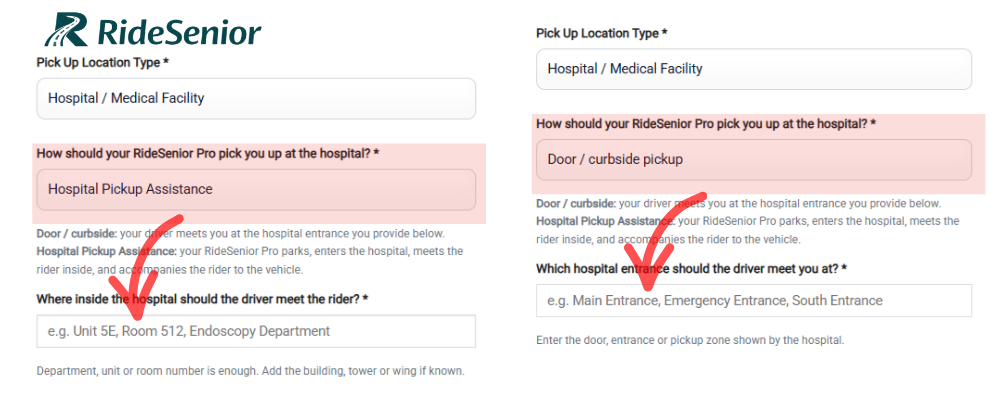
The latest RideSenior booking update is intended to address this challenge by collecting more specific hospital pickup information during the booking process. When a hospital is selected as the pickup location type, customers may now be asked to provide additional details that can help identify exactly where the passenger should be picked up.
The purpose of this change is not to make booking more complicated. In fact, the goal is the opposite. RideSenior wants to collect the right information at the time the booking is created so that customers and drivers can avoid unnecessary communication, searching, delays, or confusion on the day of the trip.
A hospital campus can be significantly larger and more complex than its street address suggests. A passenger may be waiting at the main entrance, an emergency department entrance, an outpatient clinic, a rehabilitation building, a specialized treatment centre, or another designated pickup point. Some hospitals also have multiple buildings that share the same campus address or use internal names that are familiar to patients and staff but may not be obvious to someone arriving for the first time.
For this reason, the hospital name alone may not always provide enough information for a driver to locate the passenger efficiently.
With the updated booking process, RideSenior is placing greater emphasis on information such as the hospital building, tower, wing, entrance, department, or other pickup instructions when those details are available. The exact information needed may vary depending on the hospital and the passenger’s situation. The objective is to give the assigned driver a clearer understanding of where to go before arriving at the hospital.
For example, instead of a driver receiving only the hospital name and general address, the booking may include information indicating that the passenger will be waiting at a particular building or entrance. This additional context can make a meaningful difference at large medical campuses where travelling from one entrance to another can require additional driving, parking, walking, or communication.
The update also reflects RideSenior’s focus on providing door-to-door senior transportation rather than simply moving passengers between two street addresses. Door-to-door service requires greater attention to the practical details surrounding each pickup and drop-off. For hospital trips in particular, knowing where the passenger will actually be ready for pickup is an important part of that experience.
When accurate information is available in advance, the driver can better prepare for the trip. The driver can review the pickup location, understand whether there is a specific building or entrance involved, and approach the hospital with more useful information than a general address alone. This can reduce the likelihood of the driver arriving at one side of a hospital while the passenger is waiting somewhere else.
The change can also help reduce stress for senior passengers. Leaving a hospital can already involve several steps, including discharge procedures, medication instructions, mobility arrangements, communication with family members, and waiting for transportation. A passenger should not have to spend unnecessary time trying to explain their location to a driver after the vehicle has already arrived somewhere else on the hospital property.
By requesting additional information during booking, RideSenior aims to move that coordination earlier in the process.
Family members and caregivers can also benefit from the update. A family member arranging transportation for a parent or relative may know the specific hospital building, department, or discharge area. Recording that information directly in the booking means it can be available to the RideSenior system and assigned driver instead of depending entirely on last-minute phone calls or text messages.
At the same time, RideSenior recognizes that customers will not always know every detail when creating a booking. Hospital arrangements can change, discharge locations may not be confirmed until later, and different hospitals use different terminology for their buildings and entrances. The purpose of requesting additional information is therefore to improve accuracy whenever that information is available, not to create unnecessary barriers for customers who need transportation.
RideSenior will continue working to make its booking forms straightforward and easy to understand. Additional fields are intended to appear when they are relevant to the selected pickup situation rather than requiring every customer to complete hospital-specific questions for ordinary transportation bookings.
This approach is particularly important because RideSenior serves seniors with different transportation needs. Some passengers may be travelling to a routine medical appointment and be able to enter and exit the vehicle independently. Others may need more time at pickup, travel with a walker, or require a family member or caregiver to coordinate the trip. Hospital transportation can also involve outpatient appointments, procedures, rehabilitation visits, diagnostic testing, specialist consultations, follow-up appointments, or discharge transportation.
A flexible booking system needs to accommodate these different situations without overwhelming the customer with unnecessary questions.
The hospital pickup information update is part of RideSenior’s broader effort to improve the connection between passengers and drivers. Good transportation depends on more than distance and driving directions. The quality of information available before a trip can directly affect how smoothly that trip begins.
For drivers, clear information can reduce time spent searching around large hospital campuses. It can also reduce the need to repeatedly contact the passenger or RideSenior support team for clarification. Drivers can approach the pickup with greater confidence and focus on providing a calm, professional transportation experience.
For customers, the benefit is greater clarity. When creating a booking, customers have an opportunity to communicate important location information in advance. That information stays connected to the booking and can be used to help the assigned driver locate the correct pickup point.
For RideSenior, better information also helps improve operational coordination. When a booking contains sufficient pickup details, the platform can provide more useful trip information to the driver and reduce avoidable uncertainty. As RideSenior continues expanding its senior transportation services, these operational improvements become increasingly important.
Hospital environments also demonstrate why transportation designed with seniors in mind needs to consider more than conventional navigation. A standard navigation application can direct a vehicle to a hospital address, but it may not know where a particular patient is waiting. Navigation solves the question of how to reach the property. Detailed booking information helps answer the equally important question of where on that property the pickup should actually occur.
RideSenior believes that distinction matters.
The company is therefore encouraging customers and those booking on behalf of seniors to provide as much accurate hospital pickup information as reasonably available. If a hospital has multiple buildings, identifying the relevant building can be helpful. If there is a particular entrance or patient pickup area, including that information can further improve coordination. If hospital staff have provided specific discharge or pickup instructions, those details can also be useful when appropriate.
The goal is simple: help the driver reach the right place with less uncertainty.
RideSenior also understands that transportation needs can change after a booking is created. A hospital may move a patient to another department, a procedure may finish earlier or later than expected, or staff may direct the passenger to a different exit. When important pickup information changes, customers or family members should provide updated information whenever possible so the driver can receive the most accurate details available.
This update is especially relevant to RideSenior’s hospital round-trip service. A passenger may be dropped off at one hospital entrance but need to be picked up later from a different location after the appointment or procedure. Treating the return pickup as more than simply the reverse of the outbound trip allows RideSenior to better reflect how hospitals actually operate.
The same principle applies when a family member books transportation for a senior from a hospital back to a private residence, retirement home, care home, or another destination. Accurate hospital pickup information at the beginning of the trip can help make the transition from medical care to transportation smoother.
RideSenior’s service model is built around the understanding that senior transportation often requires attention to details that may seem small but can have a significant impact on the passenger experience. Knowing the correct entrance, understanding the pickup environment, allowing appropriate time, and giving drivers useful information are all part of creating a more dependable service.
The new hospital pickup information requirements are one practical step in that direction.
As RideSenior grows, the company will continue reviewing feedback from customers, families, caregivers, and drivers to identify areas where the booking experience can be improved. Real-world transportation situations often reveal details that cannot be addressed by a simple origin-and-destination form. Hospitals, retirement communities, care homes, large residential complexes, and other multi-building locations can all require more precise information.
RideSenior’s approach is to improve the booking process while keeping it as simple as possible for the people using it.
The company does not want customers to navigate a long or complicated form filled with questions that do not apply to their trip. Instead, RideSenior is working toward a more responsive booking experience where relevant questions appear based on the type of pickup selected. When a customer is booking from a house, the system can remain simple. When a customer selects a hospital, the system can collect the additional information that may be necessary for that environment.
This creates a better balance between simplicity and accuracy.
Most importantly, the update supports RideSenior’s commitment to senior-focused transportation. Seniors and their families should be able to arrange transportation knowing that important pickup details can be communicated before the trip begins. Drivers should have the information they need to find passengers efficiently. And the booking platform should help connect those two needs in a practical way.
Adding hospital-specific pickup information may appear to be a small technical change, but it addresses a very real transportation challenge. A correct street address does not always mean a precise pickup location, particularly at large hospitals. By recognizing that difference and improving the information collected during booking, RideSenior can help reduce confusion and create a smoother experience for passengers, families, caregivers, and drivers.
RideSenior will continue refining its technology and service processes as the needs of seniors and their families evolve. Each improvement is guided by the same objective: making senior transportation easier to arrange, easier for drivers to perform, and more dependable for the people who rely on it.
With the addition of more detailed hospital pickup information during booking, RideSenior is helping ensure that drivers do not simply know which hospital to go to. Whenever the information is available, they can also have a clearer understanding of where within that hospital environment the passenger is expected to be.
For seniors leaving appointments, completing procedures, returning home after hospital visits, or relying on family members to coordinate their transportation, that extra level of clarity can make the entire journey simpler.
RideSenior remains committed to improving senior transportation one practical detail at a time, connecting better booking information with better driver preparation and, ultimately, a smoother door-to-door experience for every passenger.
RideSenior Canada
Bài viết liên quan: